

When your students write sentences, are they able to APPLY the phonics skills you’ve taught them? Or do they struggle with anything beyond single words?
Does your literacy curriculum provide you with interesting sentences for daily sentence dictation? Or are the sentences awkward and meaningless?
Do you have differentiated resources to easily support a wide range of needs in your classroom? Or does your program give you one-size-fits-all materials?
And lastly, do you have engaging real photographs to support your dictated sentences, anchoring them in your students’ memory (as well as providing vocabulary support and rich oral language opportunities!)?
If you and your students need research-based resources for sentence dictation that are both effective and engaging, I’d love to share a free set of materials with you! Below, I’ll walk you through a lesson using this free resource.
An Example of an Effective Sentence Dictation Lesson
Implementing an effective sentence dictation routine can be an easy and enjoyable part of your daily structured literacy lesson.
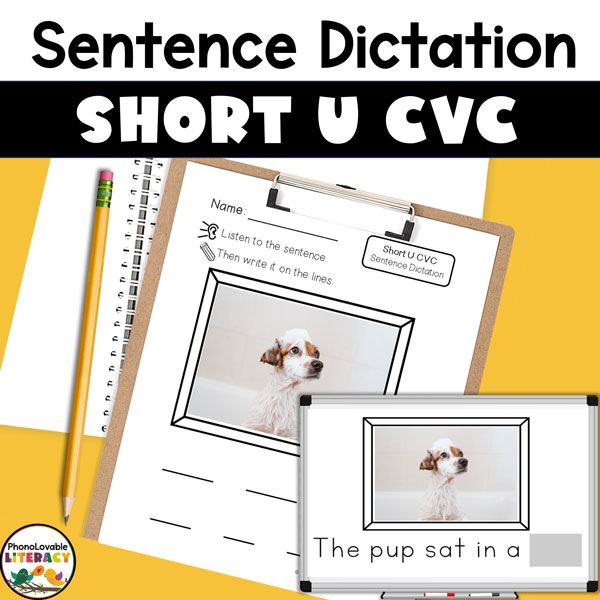
For this example, I will be using one of the sentences from our short U CVC dictation resource. You can get the entire short U resource, with all ten sentences, for free. The sentences come in differentiated print and digital versions for you to best meet your students’ needs.
Here are the simple steps to follow:
1. Have Students Look and Listen to You As You Read the Sentence
Ask your students to listen to you as you give them a sentence to write. Prompt them to watch your mouth closely as you speak each word.
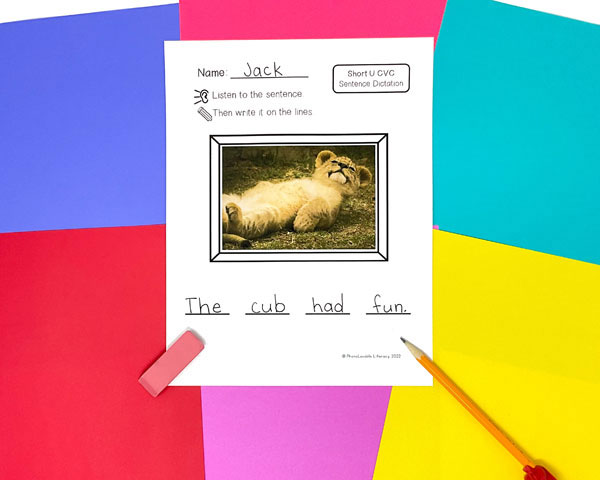
Then state the sentence, “The cub had fun.” Use exaggerated expression, especially as you emphasize the short vowel CVC words.
You can print a dictation page (like the one pictured below) for each student to keep in a folder or binder.
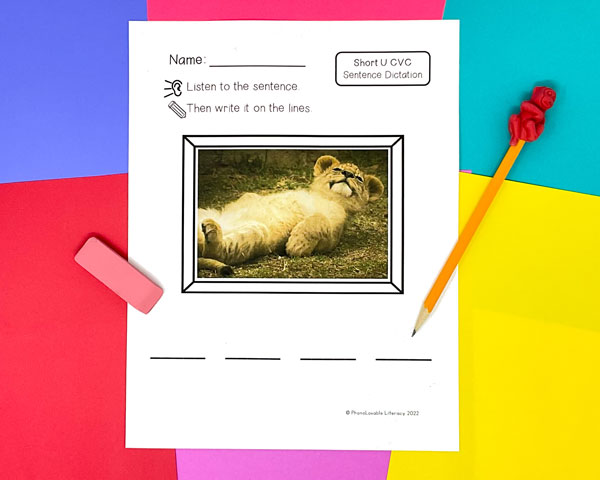
Or you can display the digital image onto a screen in your classroom. You can plan to have your students write the sentence on dry erase boards. This is a great paper-saving option.

A third option is to combine the two methods. Project the image while the students use the printed page for writing their sentence.
2. Have Students Echo the Sentence Back to You
Call out, “Fists in the air.” Tell your students to get ready to count the words in the sentence as they repeat it. Then say the sentence again: “The cub had fun.”
Your students should repeat the sentence: “The cub had fun.” As they do so, they should hold up one finger for each word.
The next step is for your students to write that number of lines on their paper or dry erase board.
Our sentence dictation resources have many differentiation options. There are four versions for students needing different levels of support. As you can see here, there is a version for:
- Writing each word on one line
- Writing each word on a separate handwriting line
- Writing the entire sentence on longer handwriting lines
- Writing only one word to complete the sentence
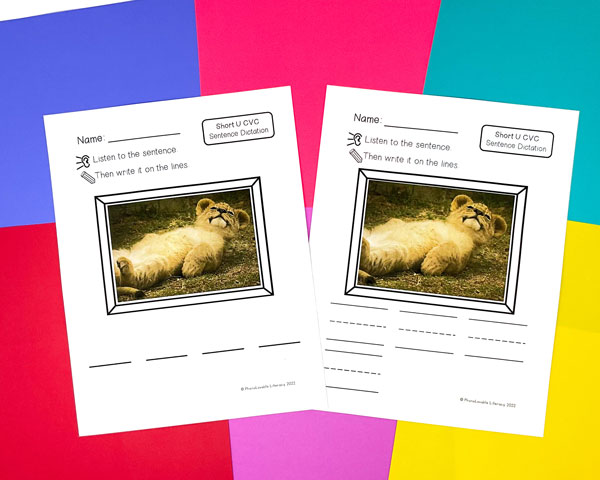
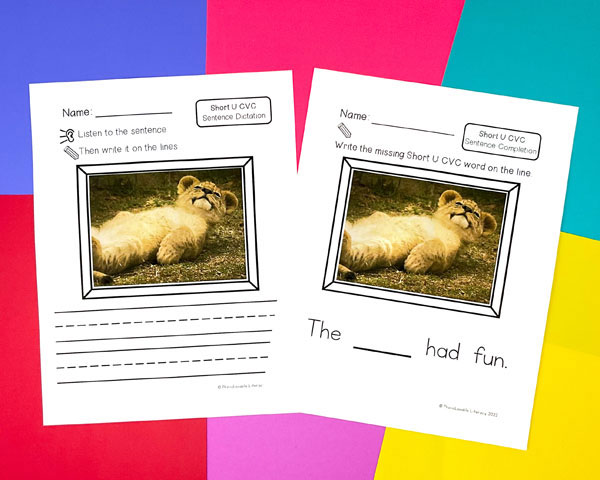
If using one of these printed sentence dictation pages, your students will either point to the lines, draw the lines, or point to the words, depending on which page they are using.
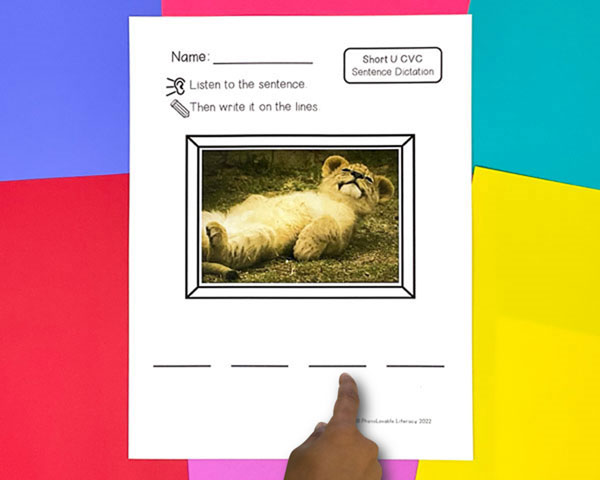
If using dry erase boards, they will draw the necessary number of lines on their boards.

There are also two advanced versions for students who are beyond the needs of sentence dictation (more on that later).
3. Have Students Write the Dictated Sentence
At this point, you are confident that your students know the sentence they need to write. They have proven this by repeating the sentence and verifying each word in the sentence. Now you have to direct them to write it!
You can do this either by saying “Write!” or by using a nonverbal cue that you have previously taught them.
4. Proofread the Dictated Sentence Together
Students usually think they are done at this point. But tell them that one of the most important (and most left out by students!) steps to writing is to proofread!
Tell your students that, as you read the sentence for the first check, they need to point to each word on their paper (or board) and check to see if anything is missing. Once they think they have all the words, they can add a check mark after their sentence.
Then tell students that, as you read the sentence again for the second time, they will make sure they have proper capitalization and any punctuation they should know. Then they can add a second check mark.
Next, tell students to check for the correct spelling of each word as you read the sentence one last time for their third check mark. Remind them to “tap out” any CVC words. If you are using a core phonics program that teaches “trick words” or “heart words” (such as the word the), you can tell them to mark those words up accordingly (circle the “trick word” or draw a heart under the irregular part of the “heart word”).
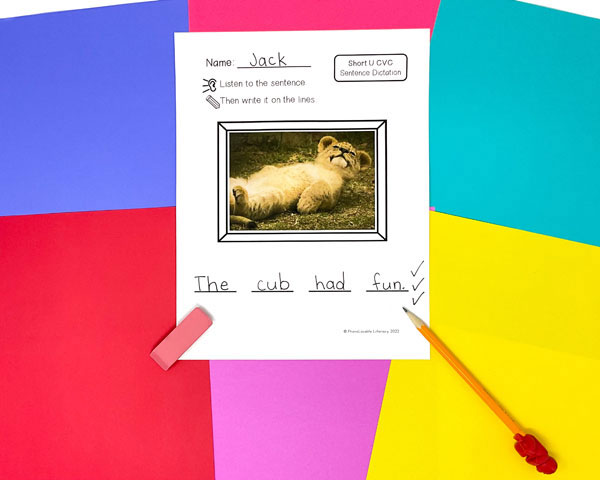
Finally, tell students to read the sentence back to you. Then ask them to help you write the sentence. If you are using your board, you can draw four lines just like your students did. Then call on students to spell each word as you write it on your board.
If using the digital slides that come with the sentence dictation resources, you have the option of revealing each word one at a time. Ask students to check their own writing with what they see on the slide.
Differentiation Options for Your Advanced Students
This lesson example is great for those students just learning to write their CVC words and apply them to basic sentences. But what about your students who can easily write much longer sentences without much effort?
Our advanced students would benefit from a more challenging task than the above sentence dictation lesson can provide.
That’s why I’ve included two advanced variations to each of the prompts in all of my sentence dictation resources.
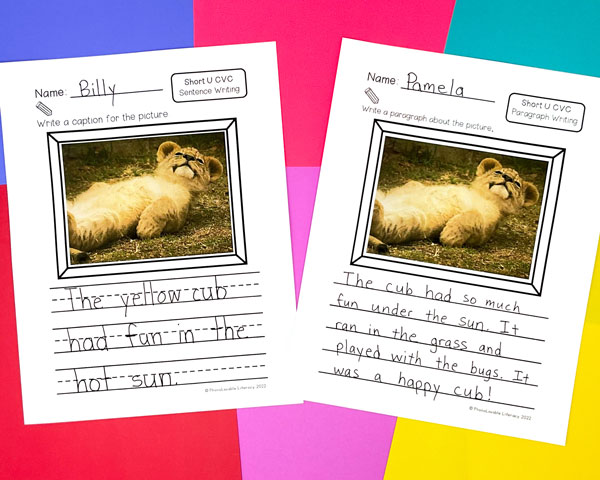
One variation allows students to make up their own caption sentence to match the picture. The other variation is for those students capable of writing multiple sentences. Let them write a descriptive paragraph, or encourage their creativity as they make up their own story!
Final Thoughts
I hope these differentiated resources help you create effective, enjoyable sentence writing experiences in your classroom.
Best wishes as your students apply their phonics skills and become confident readers and writers!