
If you’ve been in education a while, you’ve likely worked through at least a few major shifts, be it from whole language to balanced literacy to structured literacy, or from no-tech cooperative learning to “every child gets a laptop” for individualized instruction. While many of us seasoned educators aren’t swayed by lofty promises from publishers and district leaders about the newest “best thing,” we wonder how long the current trends will last and what the next shift will be.
Whether you’re already deeply entrenched in the current Science of Reading era or just beginning a shift from balanced literacy to structured literacy, you probably know that some of the popular practices of the past (sight word memorization, alphabetical word walls, picture cues and predictable text, basal readers with no authentic literature or deep dives into knowledge building) were never supported by solid reading research, and we can confidently leave them in the past.
Even though reading instruction can often feel overwhelming, especially when some students seem to learn to read almost effortlessly while others struggle with the simplest words, having a solid framework like structured literacy offers us a reliable guide for success.
How Do We Build Strong Readers Through Structured Literacy?
Strong readers are built through explicit, systematic instruction that develops phonemic awareness, phonics, decoding, encoding, vocabulary, oral language, and reading comprehension. Structured literacy gives students a clear, research-based pathway from hearing sounds to reading and writing complete sentences with confidence.
In this article, we’ll walk through the process from sound to sentence by exploring the building blocks that help students become confident readers and writers. We’ll look at phonemic awareness, phonics, decoding, encoding, vocabulary, sentence reading, and connected text—and more importantly, how these pieces work together to support young learners.
Structured literacy ensures that each skill is taught clearly, practiced purposefully, and connected to the overall goal of meaningful engagement with text.
From sound to sentence, every step matters. When we provide systematic, Science-of-Reading-aligned instruction, we give students the tools and confidence they need to become lifelong readers.
What Is Structured Literacy?
Structured literacy is an explicit, systematic approach to teaching reading and spelling that develops skills in a logical sequence from simple to more complex concepts.
Rather than hoping students discover reading patterns on their own, structured literacy teaches them directly. Teachers model new skills, provide guided practice, and gradually help students apply those skills independently.
The instruction is also systematic and cumulative. Students build on what they already know. For example, they might first learn to blend and read simple CVC words before moving on to digraphs, vowel teams, or multisyllable words. Previously taught skills continue to be reviewed, helping students strengthen and retain their learning over time.
Another important feature of structured literacy is that it is diagnostic. Teachers continually observe how students are responding to instruction and make adjustments when extra support is needed. If a child is struggling to blend sounds or apply a phonics pattern, the teacher can provide targeted instruction before moving on.
Is Structured Literacy Only for Struggling Readers?
One of the things I appreciate most about structured literacy is that while it can benefit all learners, it is absolutely vital for our students who are at risk for reading difficulties. However, even our lower-risk readers, multilingual learners, and advanced students benefit from having a clear and organized path for learning to read and write.

Many teachers have seen what is sometimes called the “fourth-grade wall.” A student appears to be an average or even strong reader in the primary grades because they have learned to rely on pictures, context clues, memorization, or educated guessing. But as texts become more complex and unfamiliar vocabulary becomes more common, those strategies begin to fall apart. Suddenly, students have difficulty accurately reading and understanding longer, multisyllable words because they never developed strong decoding habits.
Structured literacy helps prevent that problem. By teaching students to pay attention to every sound and every grapheme from the very beginning, we build a foundation that will continue to support them as reading demands increase. Students who are at risk for reading difficulties definitely benefit from this explicit instruction, but so do “on-level” readers and students who seem to pick reading up effortlessly.
When we teach all children how our written language works through structured literacy, we are not simply helping them read today’s simple books. We are preparing all students to tackle tomorrow’s challenging texts with confidence.
Is Structured Literacy the Same as the Science of Reading?
The short answer is no. The Science of Reading and structured literacy are closely connected, but they are not the same thing.
The Science of Reading is the large body of research that helps us understand how children learn to read and which instructional practices are the most effective. It draws from many fields, including education, psychology, neuroscience, and linguistics.
Structured literacy is an instructional approach to put that research into action in our classrooms.
In other words, the Science of Reading provides the “why,” while structured literacy provides much of the “how.” Research tells us that students benefit from explicit, systematic instruction in phonics, vocabulary, and language comprehension. Structured literacy organizes foundational skills into a logical sequence and gives teachers a practical framework for teaching them.
No single article can cover every aspect of the Science of Reading. It is a broad and growing field of research. But one message continues to come through clearly: when we teach reading in an intentional, systematic way, more students become successful readers.
Many people use the term Science of Reading as though it’s a program, or it means “just teach phonics.” It’s a popular point of confusion and one of several myths that can make reading instruction feel more overwhelming than it needs to be.
How Does Structured Literacy Build Strong Readers?
Structured literacy builds strong readers by explicitly teaching the skills needed for accurate word recognition, fluent reading, spelling, vocabulary, and comprehension. Instead of leaving reading development to chance, it provides a clear path that helps students build skills intentionally.
I think of reading instruction as a journey from sound to sentence. Before students can confidently understand what they read, they first need a strong foundation in how our written language works.
A structured literacy approach integrates these components:
- Phonemic Awareness – Hearing and manipulating the sounds in spoken words.
- Phonics – Learning the relationships between sounds and letters.
- Decoding – Applying those sound-symbol relationships to read words.
- Encoding – Using the same knowledge to spell and write words.
- Vocabulary – Building understanding of words, including multiple meanings.
- Sentence Reading – Combining word reading skills to construct meaning.
- Connected Text – Applying all of these skills while reading passages and books.
Each step supports the next. Students who can hear sounds are better prepared to connect those sounds to print. Students who can decode words more accurately have more mental energy available for understanding what they read. When we teach reading and spelling together, learning becomes stronger and lasts longer.
The exciting part is that these pieces are not separate programs or isolated activities. They work together to help students become confident, capable readers and writers.
Let’s look at each component from sound to sentence.
Why Is Phonemic Awareness the Starting Point?
Since our brains are naturally wired for speech, as opposed to the unnatural code of printed letters, beginning our lessons asking students to attend to spoken sounds is the perfect starting point. It engages every student and provides an unintimidating entry point to our written language.
What Is Phonemic Awareness?
Phonemic awareness is the ability to work with the individual sounds, or phonemes, in spoken words. Traditionally, these activities were often done without any print at all. In fact, many teachers were taught that phonemic awareness should happen “in the dark” because the focus was meant to stay entirely on spoken language.
Our understanding, however, continues to evolve.
More recent research and classroom practice suggest that students often benefit when phonemic awareness and phonics are integrated rather than taught as completely separate skills. Instead of spending long periods working only with phonemic awareness activities in isolation, teachers can help students connect the sounds they hear directly to the letters and spellings that represent them. After all, the goal of phonemic awareness instruction is to support reading and writing.
Another shift in thinking involves the sequence of instruction. In the past, students might spend weeks or months working on larger units of language, such as rhyming, word awareness, and syllable segmentation before ever working with individual phonemes. Today, many educators recognize that young children, including kindergarten students, are often capable of learning to blend and segment phonemes right from the beginning when they receive explicit instruction and appropriate support.
That doesn’t mean larger units of sound are unimportant. But because our alphabetic writing system represents phonemes, teaching students to hear, blend, and segment those individual sounds gives them a powerful foundation for both reading and spelling.
If reading is a journey from sound to sentence, phonemic awareness is where that journey begins.
Signs Students Need More Phonemic Awareness Practice
Phonemic awareness difficulties are not always obvious. In fact, students may appear to know their letter sounds in isolation but still struggle because they are not hearing and processing all of the sounds within words.
One common sign is difficulty blending sounds together. A student might hear /m/ /a/ /t/ but be unable to put those sounds together to say the word mat.
Other students have trouble segmenting words into individual phonemes. They may know how to read the word ship but struggle to identify that it contains the sounds /sh/ /i/ /p/. These students often have difficulty spelling because they are not hearing every sound they need to write.
The good news is that these skills can improve with explicit instruction. Short, daily opportunities to blend, segment, add, delete, and substitute sounds—especially when connected to letters and spelling—can help students build a stronger foundation for both reading and writing. This is where minimal pairs and word chains during our structured literacy lessons provide powerful practice.
If you are looking for simple ways to strengthen these skills, you may also enjoy 5 Useful Structured Literacy Activities That Will Motivate Your Students.
Why Do Some Students Guess Instead of Read Words?
Students do not guess because they are lazy or unmotivated. They guess because, at some point, guessing worked.
A child who looks at the picture, notices the first letter, and says horse instead of house may appear to be reading. Another student might memorize a familiar book and recite it from memory. These strategies can help children get by when texts are simple and predictable. However, they do not build the decoding habits needed for long-term reading success.
As books become more complex and picture support fades, guessing becomes much less effective. Students eventually encounter unfamiliar words that cannot be solved with context clues or pictures alone. They need to be able to look at the letters, connect them to the correct sound, and blend those sounds together to read the word accurately.
Why Explicit Phonics Matters
This is where explicit phonics instruction makes such a difference.
Our alphabetic system is not something students naturally figure out. Explicit phonics instruction helps students build that knowledge step by step. Rather than expecting children to discover patterns on their own, teachers model new concepts, provide guided practice, and gradually increase complexity over time. They need direct teaching that introduces sound-spelling correspondences in a logical progression from simple to more complex patterns. Just as importantly, they need repeated opportunities to apply those skills while reading and spelling.
This systematic approach gives students a reliable strategy for reading unfamiliar words. Instead of relying on memory or context clues, they learn to look at the letters, connect them to their sounds, and blend those sounds together.
These decoding habits become increasingly important as students encounter longer and more challenging words in later grades.
What Are Word Chains and Why Are They So Effective?
Word chains are a simple but powerful structured literacy activity that helps students build accurate decoding and spelling habits. In a word chain, students read or spell a series of words while changing just one sound or spelling at a time.
For example:
sat → sit → sip → tip → top
Word chains are basically a string of minimal pairs—words that differ by only one phoneme, such as pin and bin or cap and cup. These small changes help students hear that changing a single sound changes the entire word.
Instead of guessing, students must pay attention to every phoneme and every grapheme. That careful analysis strengthens the same skills they need when reading unfamiliar words independently.
Word chains may look simple, but they teach students that every sound matters.
How Word Chains Work
We can use word chains for both reading and spelling. The teacher presents a starting word. Then, students change one sound or spelling to create the next word in the sequence.
For example, if students begin with the word sat, they might change the /a/ to /i/ to make sit. Then they could change the final sound to create sip.
As students work through the chain, they must identify which sound changed, connect that sound to the correct spelling, and blend the new word. When used for spelling, they also segment the word into its individual phonemes before writing it.
Minimal pairs are a good starting point. We ask students to focus on only two words at a time, such as nap and snap or not and note. Whether changing fan to van or coat to goat, students learn that one small difference can completely change the meaning of a word. And guessing gets us nowhere!
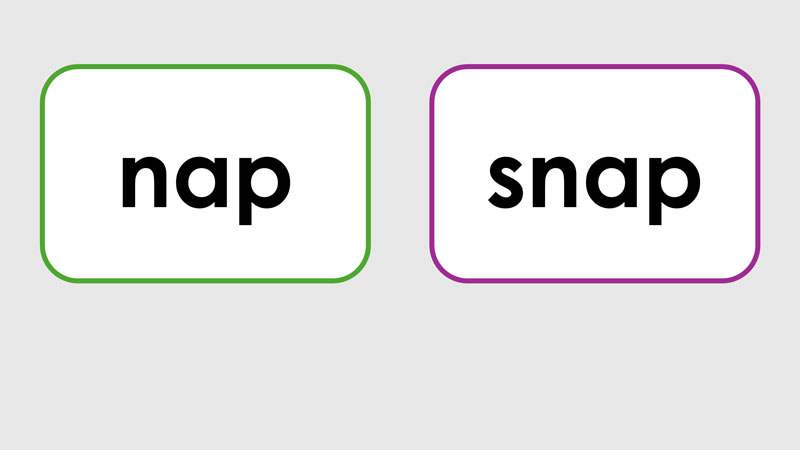
Minimal pairs and word chains are minimal-prep and also fantastically flexible. They can be practiced with printed words, magnetic letters, or whiteboards. They can even be practiced with real photographs that help build vocabulary and background knowledge. When I use photographs, I want students to connect the image to the meaning of the word. I do not want them to guess the word from the picture. The decoding always comes first.
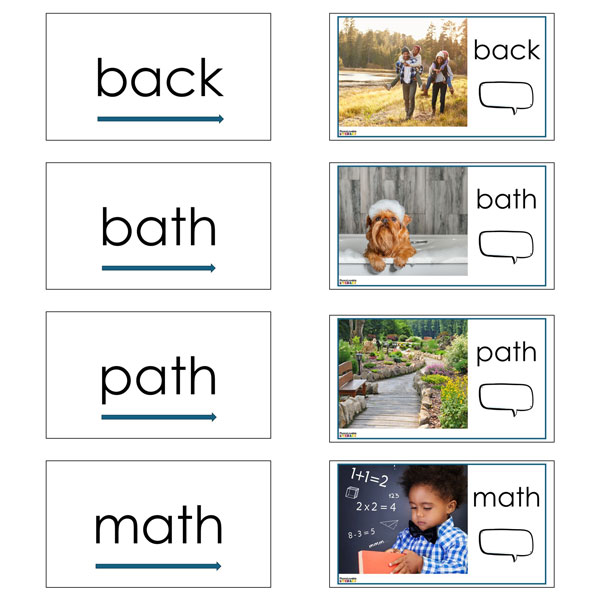
This constant comparison between sounds, spellings, and meanings encourages careful listening and close attention to print.
Why Word Chains Build Better Readers
One of the biggest benefits of minimal pairs and word chains is that they help students replace guessing with accurate decoding habits.
Rather than looking at the first letter and making a prediction, students learn to examine every sound and every grapheme. They discover that leaving out or changing even one phoneme creates a completely different word.
This repeated attention to detail supports orthographic mapping, the process of storing words in long-term memory for automatic recognition. It also strengthens the reciprocal relationship between reading and spelling because students are constantly connecting sounds and symbols.
I also appreciate that word chains naturally integrate several important literacy skills at once. Students practice phonemic awareness, phonics, decoding, and encoding within a single activity.
Over time, this careful, analytical approach helps students become more accurate readers. They become more confident spellers. They become more efficient at tackling unfamiliar words.
Why Students Love Them
Minimal pairs and word chains are highly effective, but they are also fun. It feels like a game to students. I challenge them to not be tricked, or to be like a detective—looking carefully for what’s different in each pair or chain of words.
Students enjoy the challenge of figuring out what the next word will be and discovering which sound has changed. Because each step builds on the last one, they experience frequent success, which helps build fluency and confidence.
For added interest, I like to add a mystery picture that is revealed as students complete the chain. This simple twist adds excitement and gives students extra motivation to stay engaged.
I also like that word chains feel more like a puzzle than a worksheet. Students become active problem solvers, carefully listening, thinking, and applying what they know about our language.
Perhaps most importantly, they can see their own growth. A student who once guessed at words begins to realize, “I can figure this out by looking at all of the sounds and letters.” It leads students to rightfully believe, “I can read!”
Why Should Reading and Spelling Be Taught Together?
Reading and spelling strengthen the same sound-symbol connections. When students learn these skills together, they build a deeper understanding of how our written language works. Rather than treating them as separate subjects, structured literacy recognizes that each one supports the other.
What Is the Difference Between Decoding and Encoding?
Decoding is reading print and turning it into spoken language. Encoding is taking spoken language and representing it with letters to spell words. They go hand in hand.
When students read the word ship, they connect the letters s-h-i-p to the sounds /sh/ /i/ /p/. When they spell the word, they reverse the process by listening for those sounds and choosing the correct spellings. Both tasks strengthen the same underlying knowledge.
Why Reading and Spelling Strengthen Each Other
This reciprocal relationship is one reason structured literacy places such a strong emphasis on integrating reading and spelling instruction. Spelling requires students to pay attention to every phoneme and every grapheme. This makes it much harder to rely on guessing habits. The careful analysis students use while spelling also supports more accurate word reading.
How Sentence Dictation Builds Strong Readers
One of my favorite ways to bring these skills together is through sentence dictation. Students enjoy it, too! During a dictation activity, students first listen to a sentence. Then they segment words into sounds, apply phonics patterns, and think about capitalization and punctuation. They finish by rereading what they have written to make sure it makes sense.
In a single sentence, students are practicing phonemic awareness, phonics, spelling, grammar, handwriting, and comprehension. They are not simply copying words from the board—they are actively applying what they know about our language.
Sentence dictation helps students see the connection between reading and writing. The same knowledge that helps them decode words can also help them become more confident and capable writers.
How Do Decodable Texts Help Students Apply Their Skills?
Decodable texts give students an opportunity to apply the skills they have been learning in connected reading. They bridge the gap between practicing individual sounds and words and reading complete sentences and stories with enjoyment and confidence.
If structured literacy is a journey from sound to sentence, decodable texts are where students can put all of the pieces together. They apply taught sound-spelling patterns to decode unfamiliar words, and practice appropriate phrasing and expression. At the same time, they are constructing meaning from what they read, the ultimate goal of reading.
Rather than asking students to rely on pictures or context clues, effective decodable texts encourage them to use the decoding strategies they have been explicitly taught. This helps build the accurate reading habits that will support them as texts become more challenging.
Decodable texts are not meant to replace rich read-alouds or authentic literature. Instead, they provide a place for students to practice new skills successfully while developing confidence as readers.
By the time students are independently reading connected text, they are no longer working with isolated sounds or single words. They are taking the entire journey from sound to sentence.
What Makes a Decodable Text Effective?
An effective decodable text closely matches the phonics skills students have already learned. Most of the words should contain sound-spelling patterns that are familiar. Also, the text should include explicitly taught irregular high-frequency words (“heart words” or “trick words”). This allows students to practice new concepts without becoming overwhelmed.
A good decodable also tells a meaningful story or shares interesting information. Students should feel like they are reading for a purpose, not simply calling out words for decoding’s sake.
Effective decodables should provide a high rate of success. When students can accurately decode most of the words on the page, they build confidence and strengthen the reading habits we want them to develop. They see themselves as readers.
Even though the bulk of vocabulary and knowledge building belongs in our rich read-aloud time, vocabulary and comprehension can definitely be incorporated into decodable text reading. As students read each paragraph or page, teachers can discuss the story, ask questions, and deepen knowledge. Reading is about understanding language, not just saying the words correctly.
The best decodable texts help students practice the code while remembering that the ultimate goal of reading is meaning.
How Often Should Students Read Decodable Texts?
Students benefit most when we use decodable texts consistently. Short, daily practice is often more effective than occasional longer lessons.
Decodables can be incorporated into whole-group phonics instruction, small-group lessons, intervention time, tutoring sessions, or independent practice. They also work well for repeated readings, giving students opportunities to increase both accuracy and fluency.
The key is to match the text to the skills students have already been taught. If a passage contains too many unfamiliar patterns, students may become frustrated and return to guessing strategies. When the text is appropriately controlled, they can focus on applying what they know.
I also like to revisit decodable texts after introducing new skills. I often let my students choose “an old book,” asking them to select a favorite they’ve read in the past. Students often enjoy seeing how much easier a passage feels after additional practice, and that success helps build confidence.
A few minutes each day spent reading connected, decodable text can have a lasting impact. Students are continually applying the knowledge they have worked to develop.
What Makes Decodable Texts Engaging?
If you think decodable books are dry and meaningless, you might be remembering the materials many of us saw years ago. Old decodable sets often featured awkward language and minimal storylines. Sentences like “Kip did nip six figs” may technically provide phonics practice, but they are not the kind of language children naturally hear or use.
Fortunately, we have many more engaging options today!
A strong decodable text should have something worth talking about. Funny or relatable characters, interesting plots, and engaging nonfiction topics can spark conversations and build background knowledge while students practice their reading skills. My own students often laugh at witty storylines and talk about the characters as if they are real friends. They also ask countless questions after reading interesting nonfiction passages about the world around them.
I also prefer decodable books that avoid placing pictures on the same page as the text whenever possible. Students should first rely on the letters and sounds to identify words. Pictures can add interest, but they should reinforce meaning after decoding has taken place. They should not become a crutch for guessing.
Let’s say there’s a decodable book we love, but it has pictures right alongside text. I tell my students to cover up the picture as soon as they turn the page. If it’s a small group and the first time I’m introducing the book, I’ll cover the pictures with large sticky notes in advance. This allows them the reward of ripping off the sticky after they carefully read the words. Or to avoid this extra step entirely, I look for books with the picture on the back page, or text-only passages with the space for students to illustrate the story themselves.
Using decodables does not mean abandoning rich read-alouds or authentic literature. It is never an either-or choice. Strong literacy instruction weaves all of these experiences together to build joyful, capable readers.
When used intentionally, decodable texts help students practice the foundational skills that will eventually allow them to read any book of their choosing.
How Can Real Photographs Support Vocabulary and Oral Language?
Capable readers need more than accurate decoding skills. They also need a rich vocabulary, strong oral language abilities, and background knowledge about the world around them.
These language comprehension skills are essential for reading success, yet they are sometimes treated as separate from structured literacy instruction. I don’t think they should be.
As students move from sound to sentence, they are also building meaning. Even a simple phonics lesson can become an opportunity to build new vocabulary, encourage discussion, and strengthen oral language.
The goal is not to turn every phonics lesson into a science or social studies lesson. Instead, it is to recognize that small conversations around words and sentences can gradually build the language foundation that supports later reading comprehension.
Structured literacy helps students unlock the words on the page. Vocabulary and oral language help those words come alive.
Why Vocabulary Matters for Reading Success
Reading is about much more than saying the words correctly. Students also need to understand what those words mean.
A child may accurately decode the word sob. However, if they do not understand that sobbing is a type of crying that is stronger than simply being sad, they are missing an important layer of meaning. This is one reason vocabulary, oral language, and background knowledge are so important.
Many phonics programs focus primarily on helping students crack the alphabetic code, and that work is essential. But we can also use the words and sentences we are already teaching to strengthen language comprehension at the same time.
The good news is that this does not require a separate vocabulary block. A quick routine can make a big difference. After students successfully decode a new word, we might provide a kid-friendly definition, share an example and a non-example, and ask a simple question to check for understanding.
“To sob means to cry hard because you are very sad or upset. If you scrape your knee and shed a single tear, you might not sob. If you lose your favorite stuffed animal and can’t stop crying, you might sob. Turn to your partner and tell about a time a story character might sob.”
Students can also use the word in a sentence or, even more fun, act out its meaning as a group. These brief experiences take only a minute or two, but they help students connect new words to real experiences while strengthening the oral language skills that support future reading comprehension.
Why Real Photos Can Be Powerful
Real photographs can be a wonderful tool for building vocabulary and oral language. They connect printed words to a real experience.
Unlike simple clipart, photographs often contain rich details that encourage students to observe, describe, compare, and ask questions. They can spark conversations that build background knowledge and give students a stronger understanding of the words they are learning to read.
I have also found that real photos can be especially helpful for students who are learning English or who have had fewer opportunities to encounter certain vocabulary words in everyday life.
A photograph of an ox, dune, or sprout can open the door to meaningful discussion while students are practicing a phonics skill. In this way, the same lesson can strengthen both the word recognition and language comprehension strands that support skilled reading.

Small moments of conversation today can become the background knowledge students rely on when they encounter those same ideas in future texts.
A Common Misunderstanding About Pictures
When I talk about using photographs during phonics instruction, I am not suggesting that students should use pictures to guess words.
In fact, I am expressing the opposite.
Students should first use the letters and sounds to decode the word. Once the word has been accurately read, the photograph can help confirm meaning, build vocabulary, and encourage oral language.
For that reason, I do not place pictures on the same page or slide as the words students are decoding. This helps establish the habit of looking at the print first. After the reading work is done, the image can become a springboard for discussion.
For encoding, I show the picture first and ask students to repeat and segment the word into sounds orally. Then, they write the letters on paper or a dry-erase board. This use of a picture is to help students understand and remember the word (or sentence) they are meant to spell and write.
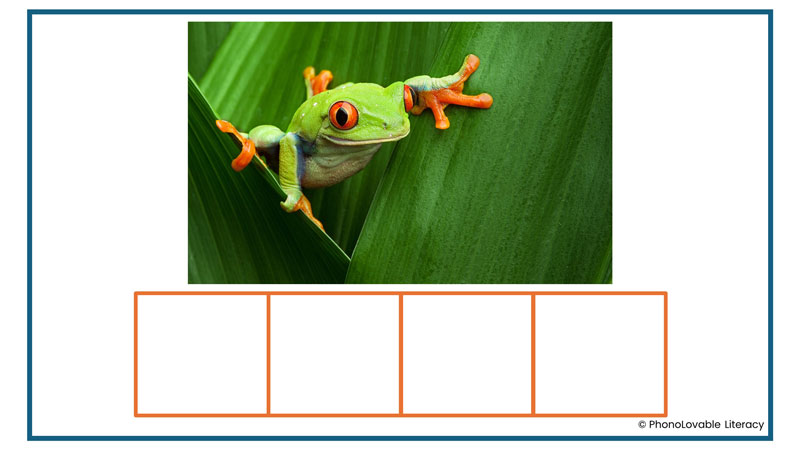
This practice allows us to accomplish two important goals at the same time. Students build strong decoding habits while also strengthening the vocabulary, oral language, and knowledge that support long-term reading comprehension.
We don’t have to choose between teaching the code and building meaning or saving “comprehension” for a later time in our literacy block. We can make our foundational phonics instruction even stronger by intentionally integrating oral language and knowledge whenever possible.
What Does a Structured Literacy Lesson Look Like?
A structured literacy lesson is not a collection of phonics activities. Each part is intentionally designed to build on the one before it, helping students move from hearing sounds to reading and writing connected text.
The exact format may vary from classroom to classroom, but effective lessons are typically explicit, systematic, and cumulative. Students review previously taught skills, learn something new, and then apply that learning in meaningful ways.
One of the things I appreciate most about structured literacy is that it allows multiple strands of reading development to work together. A single lesson can strengthen phonemic awareness, phonics, decoding, spelling, vocabulary, oral language, and comprehension without treating them as completely separate subjects.
As we’ve seen, the goal is not simply to help students read isolated words. The goal is to help them understand and communicate meaning.
When we thoughtfully connect these pieces, we create a clear pathway that helps students progress from sound to sentence with confidence.
Example Lesson Sequence
A structured literacy lesson might include a sequence like this:
- Phonemic Awareness Warm-Up – Start with speech and connect the sound to print.
- Introduce or Review the Phonics Skill – Explicitly teach the target pattern.
- Word Reading Practice – Read words containing the new pattern.
- Word Spelling Practice – Segment and encode those same words.
- Build Vocabulary and Oral Language – Briefly discuss the meaning of new words.
- Sentence Reading – Apply the skill in meaningful sentences.
- Sentence Dictation – Integrate listening, spelling, grammar, and writing.
- Connected Text Reading – Read a decodable passage or story that allows students to apply their learning.
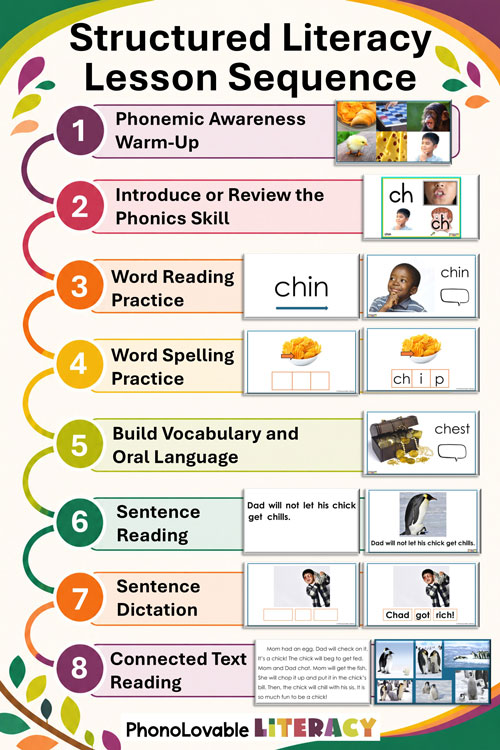
Consistent practice can have a powerful impact when the activities work together toward a common goal.
How These Pieces Work Together
Each part of a structured literacy lesson strengthens and reinforces the others.
Phonemic awareness helps pay close attention to the sounds in words. Phonics strengthens the connections between sounds and symbols. Word reading and spelling give students opportunities to apply that knowledge. Vocabulary and oral language improve comprehension. Sentence reading and dictation help students combine individual skills into authentic reading and writing experiences.
Finally, connected text allows students to bring everything together. Instead of practicing isolated skills, they experience the satisfaction of reading meaningful sentences and stories successfully.
If you’re interested in some done-for-you lessons that put these pieces together and incorporate real photographs, feel free to take a look at our collection.
Building Strong Readers Takes Time
There is no single activity, worksheet, or program that instantly creates strong readers. Reading develops over time as students participate in many small, intentional learning experiences.
Throughout this article, we’ve talked about the journey from sound to sentence. Students learn to isolate and manipulate sounds through phonemic awareness. They connect those sounds to letters through explicit phonics instruction. They build accurate decoding habits with activities like word chains and strengthen those same connections through spelling and sentence dictation. Decodable texts give them opportunities to apply their skills. Vocabulary and oral language help bring meaning to the words they read.
These pieces work together. None of them stands alone.
Consistency matters more than perfection. Consistent, explicit instruction day after day has a tremendous impact. When students regularly practice these interconnected skills, they gradually build the strong foundation needed for fluent reading, confident writing, and deep comprehension.
I’ve seen students who once relied on guessing become careful decoders.
I’ve watched reluctant readers gain confidence and begin to see themselves as capable readers.
Strong readers are not built in a single lesson. They are built one sound, one word, one sentence, and one meaningful conversation at a time.

Related Articles
You may also enjoy:
Simple Word Chains Make a Big Difference in Decoding
5 Useful Structured Literacy Activities That Will Motivate Your Students
Continuous Blending Strategies to Make Emerging Readers Happy